


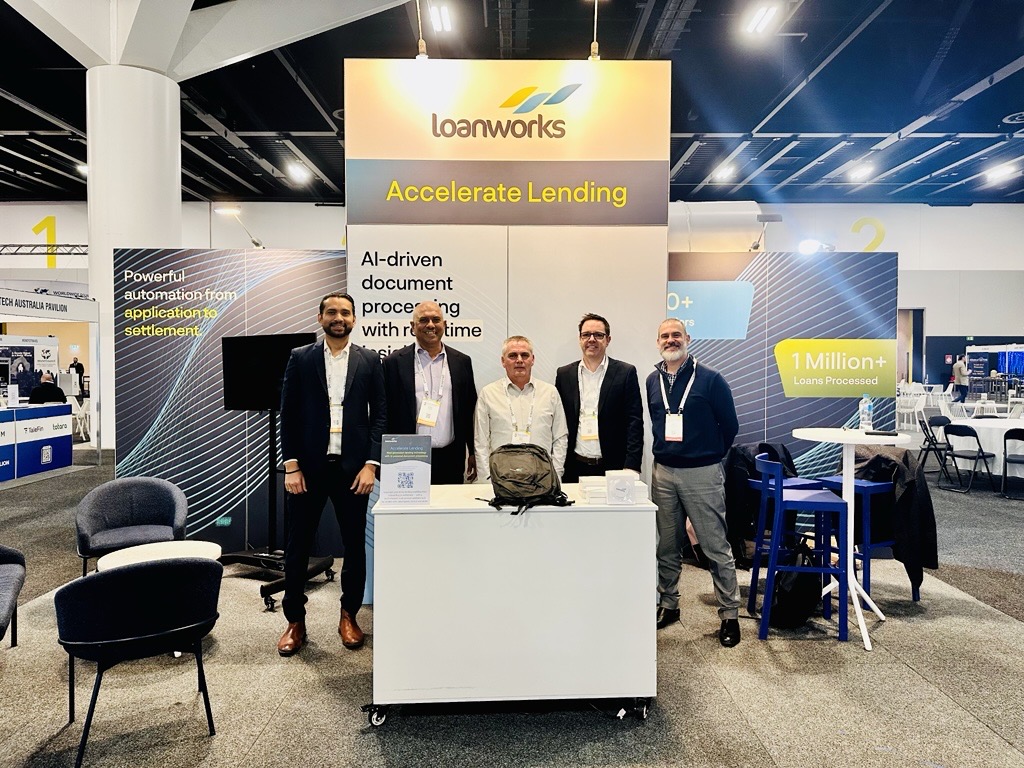
The banking transformation conversation has a familiar problem right now: everyone’s talking about AI, but far fewer people can show you what it’s actually done. That gap was the single biggest theme running through this year’s World Credit Union Conference (WCUC) − on the exhibition floor, in the session rooms and in the conversations Loanworks had along the way.
Here’s what stood out.
Former Prime Minister, Julia Gillard, opened proceedings with a keynote tracing the history of credit unions back to their roots: community-based, pooled financial services built on close relationships between people, their communities, and the local economy. Her argument was that this model is as relevant today as it ever was.
It’s hard to disagree with the premise. A close connection to individuals and community genuinely can produce more tailored financial solutions − and a local credit union is often better placed to do that than a large, distant institution.
- But sitting in the session rooms and walking the floor at WCUC, it was hard not to notice how much pressure is pulling credit unions in the opposite direction:
- Changing demographics: The typical member is more mobile, more tech-savvy, more financially literate, and far more willing to shop around. For highly commoditised products like home loans, people increasingly just want fast, no-fuss service.
- Regulation: Compliance obligations keep evolving, and managing that risk takes resources that are hard to find without scale − which is presumably why so many regulatory compliance (‘RegCo’) providers had a presence at the event.
- Technology: Transformation, automation, and AI dominated the conference agenda − Loanworks included. All of it is genuinely useful for keeping up with changing member expectations and unlocking internal efficiency. But there’s a real tension here: the more a credit union automates, the further it can drift from the personal, community-based connection the keynote was championing.
- Scale: Most credit unions lack it, and that’s increasingly a competitive handicap. Demographics, regulation, and technology all demand capital and skills that scale makes easier to find. It’s part of why we’ve seen mergers and amalgamations in recent years − though so far, that’s mostly played out among the larger players, widening the gap with smaller ones.
- Competitive pressure: Credit unions have always competed with banks. Increasingly, they’re competing with each other too, as more of them move beyond their traditional community boundaries.
None of this makes the keynote wrong. It’s more that the sector is trying to hold onto its founding purpose, while operating in conditions that make that purpose harder to deliver on. That tension showed up again and again across the two days.
The AI hype gap
AI messaging showed up on roughly six in ten stands this year. Real, operational evidence of what that AI actually does? Much harder to find.
A handful of exhibitors bucked the trend and one took a refreshingly pragmatic, consultative line with their pitch: rather than opening with a feature list, they asked, “What does AI mean for you?” It’s a small shift in framing, but it says a lot – the conversation starts with the customer’s problem, not the technology.
The bigger pattern, though, was one of fatigue. More than one conversation on the floor echoed the same sentiment: the market is tired of AI being bolted onto every initiative without a clear commercial case or a real look at whether it fits the operating model. Substance is starting to matter more than the label.
What actually separates successful transformations
Beyond the AI conversation, one of the most useful session takeaways was a simple framework for technology transformation . Four themes fundamental to success came through clearly:
- Transformation is a whole-of-enterprise shift, not a technology upgrade. Treating it as an IT project is one of the most common reasons transformations underdeliver.
- SaaS doesn’t remove complexity it relocates it. Moving to SaaS trades build complexity − for operating-model complexity. Someone still has to own that.
- Trust is the real success metric. Regulatory trust, customer trust, and board trust matter more than any go-live date.
- Sequencing decides the outcome. How you stage and transition the work is often the difference between success and failure − more than the technology choice itself.
Five ways to migrate − and none of them is ‘just switch it on’
The session mapped out five staged migration patterns institutions are using in practice — from tranche-based customer cut-overs to incremental core renovations — each trading off speed, disruption, and how long legacy systems stay in the mix. Whichever pattern an institution chooses, the key drivers of success remain – to protect trust along the way: maintain visible senior leadership, deliver value early rather than saving it all for the finish line, and to ensure genuine confidence in the data itself.
Assurance isn’t a final checkpoint it’s continuous
The last piece worth sharing is how thinking has shifted on assurance and validation. Boards and regulators expect different things at different stages: sound plans and clear accountability before migration starts, honest visibility into progress and defects while it’s underway, and proof that performance and benefits actually match what was promised once it’s live.
The strongest approach treats assurance as continuous rather than a series of checkpoints, built on four pillars: embedded risk visibility and governance, data-driven and predictive oversight, automated risk assurance built into CI/CD pipelines, and a cloud delivery-and-insight platform that ties it all together.
What credit unions actually asked us
It was telling that almost every conversation at our stand circled back to three practical questions:
- How do we upgrade our origination and get to automated, seamless processing − without major disruption along the way?
- What’s the actual uplift if we make the change?
- How do we manage the change itself?
Those questions are really the whole conference in miniature. Credit unions aren’t asking whether to modernise − they’re asking how to do it without losing what makes them a credit union in the first place.
Where Loanworks fits in
That’s the exact problem we’ve spent 20+ years working on. Quantum, our AI-driven origination platform, and Document Intelligence are built to automate the parts of the loan journey — from application through to decisioning — that traditionally slow institutions down, without requiring a rip-and-replace of everything else. Our commissions processing and originator portal work the same way: designed to sit alongside existing operations rather than force a disruptive overhaul.
On the uplift question, the numbers speak for themselves: institutions on our platform have seen time to ‘yes’ cut by around 30%, across a network that’s now processed over a million loans. And on managing the change itself, that’s as much about partnership as it is about software — something reflected in the work we’ve done with, each of whom came to us wanting to modernise origination without losing what made their offering distinct.
It’s the same balance the sector is wrestling with more broadly: adopt the technology, keep the trust.
The takeaway
If there’s one thread connecting all of this, it’s that transformation − AI included − is won or lost on substance, sequencing, and trust, not on how confidently it’s pitched from a stand. WCUC 2026 was a useful reminder that the institutions and vendors getting real results are the ones asking what the technology is actually for, before they ask how fast they can roll it out.
For a sector built on community, that question matters more than most. We came away with plenty to think about − and we’re looking forward to helping our customers find their own answer to it.